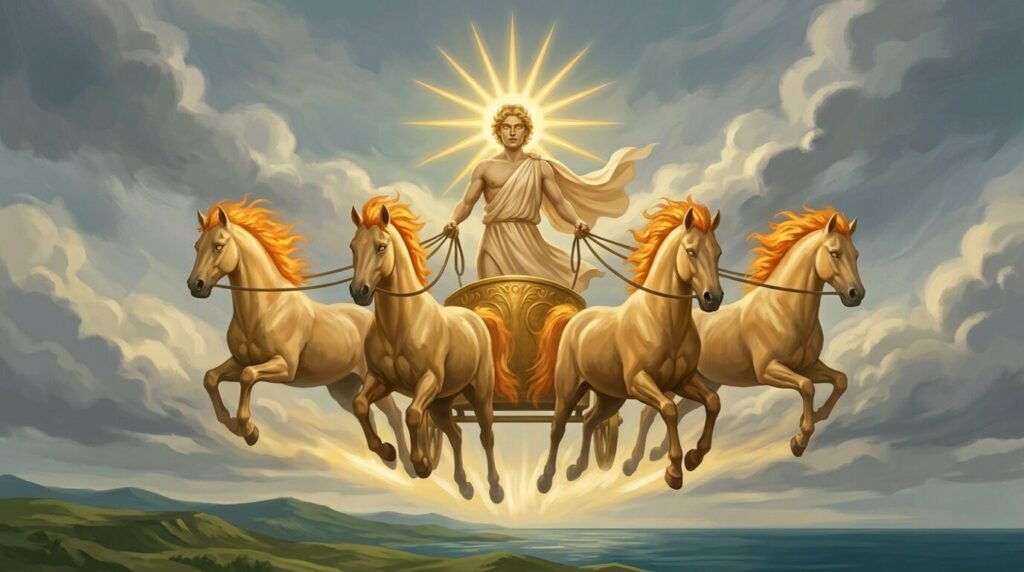
Around AD 53, Paul spent two years in Ephesus — a city soaked in magic and star-religion. The Biblical book of Acts records two scenes from those years. In the first, a band of traveling exorcists try to wield Jesus’ name over a violent spirit and are thrown out of the house beaten and stripped. The shock runs through the city’s magicians, who haul their spellbooks into the open and burn them — the value was fifty thousand pieces of silver.[1] In the second scene, a riot fills the town theater to defend the goddess Artemis when Paul’s preaching threatens her cult and the trade around it.[2]
A few years later Paul writes back to that same city. And when he names the real enemies he views Christians as wrestling against, he reaches for a rare word that came straight out of the world of those burned spellbooks: kosmokratōr — “world-ruler.”
In brief. Kosmokratōr (κοσμοκράτωρ, “world-ruler,” also spelled kosmokrator) is the rare Greek word Paul uses in Ephesians 6:12 for what he sees as hostile spiritual “cosmic powers.” His first readers already knew it from astrology and magic, where it named the sun-god and the fate-dealing planets believed to rule the cosmos — and where it was a title of honor, if not awesome and fearful respect.
- It appears only once in the Bible — Ephesians 6:12.
- English Bibles translate it many ways: cosmic powers, world rulers, world forces, powers of this dark world.
- It’s built from kosmos (“ordered world”) + -kratōr (“ruler”) — the same -kratōr in Pantokratōr (“Almighty,” a title of God) and Autokratōr (“emperor”).
- In Greek and Roman culture it named gods and planets thought to rule fate; magic promised humans limited power over them as well as escape from them.
- Paul repurposes the word to mean hostile spiritual powers — and says Jesus has already disarmed them (Colossians 2:15).
What is a kosmokratoras, and where does it appear in the Bible?
It appears exactly once in the New Testament, in Ephesians 6:12 (ESV):
“For we do not wrestle against flesh and blood, but against the rulers, against the authorities, against the cosmic powers over this present darkness [Greek: tous kosmokratoras tou skotous toutou], against the spiritual forces of evil in the heavenly places.”[3]
That single appearance is what scholars call a hapax legomenon — a word used only once. It appears nowhere in the Greek Old Testament (the Septuagint), and not in the prominent first-century Jewish writers Philo and Josephus either.[4] So we can’t lean on other biblical verses to tell us what it means. We have to go to the word itself, and to the world Paul borrowed it from. The standard Biblical lexicon translates it simply: “world-ruler.”[5]
Why do Bibles translate it so differently?
Because one dense Greek word has no clean English match, translators split several ways — which is why you may have searched for any of these:
| Translation | Renders kosmokratoras as… |
|---|---|
| Vulgate (Latin, 405) | “world-rulers of these darknesses” |
| Wycliffe (1382) | “governors of the world of these darknesses” |
| Tyndale (1534) / KJV (1611) | “the rulers of the darkness of this world” |
| Young’s Literal (1862) | “the world-rulers of the darkness of this age” |
| NIV | “the powers of this dark world” |
| NASB | “the world forces of this darkness” |
| ESV / NRSV / CSB | “the cosmic powers of this present darkness” |
| NET | “the world rulers of this darkness” |
| Hart (2022) | “the Cosmic Rulers of this age’s darkness” |
Two things are worth noticing. First, some translations keep the “world/cosmos” idea visible (“world rulers,” “cosmic powers,” “world forces”), while others fold it into an adjective on darkness (“this dark world“). Second, the phrase “of this darkness” most likely marks the realm these powers rule — they are world-rulers whose domain is “this present darkness.” No single English phrase carries everything the one Greek word did.[6]
Where does the word come from?
Kosmokratōr is a compound of two older words.
Kosmos did not originally mean “the universe.” In early Greek it meant “order” or “arrangement” — even a woman’s adornment (the root of our word cosmetic). The philosopher Pythagoras is credited with first applying it to the whole ordered universe. So underneath “world” is the idea of an ordered system.
-Kratōr means “ruler,” from krateō (“to rule, to be strong”) and kratos (“strength, might”).
Put together: “ruler of the ordered world.” And here is the part worth sitting with — that -kratōr ending sat in a small, loaded family of words:[7]
- Pantokratōr — “Almighty,” ruler of all: the Greek title the New Testament used for the one Christians called the Lord Almighty (often in Revelation).
- Autokratōr — “self-ruler“: the standard Greek word for the Roman emperor.
So kosmokratōr was formed on the same pattern as the two high titles of power a first-century reader knew — God’s and Caesar’s. (The shared word-formation is a fact of the grammar; reading Paul’s word as a deliberate rival to those titles is a reasonable inference from that kinship, not something the sources state outright.)
What did the word mean in Paul’s world?
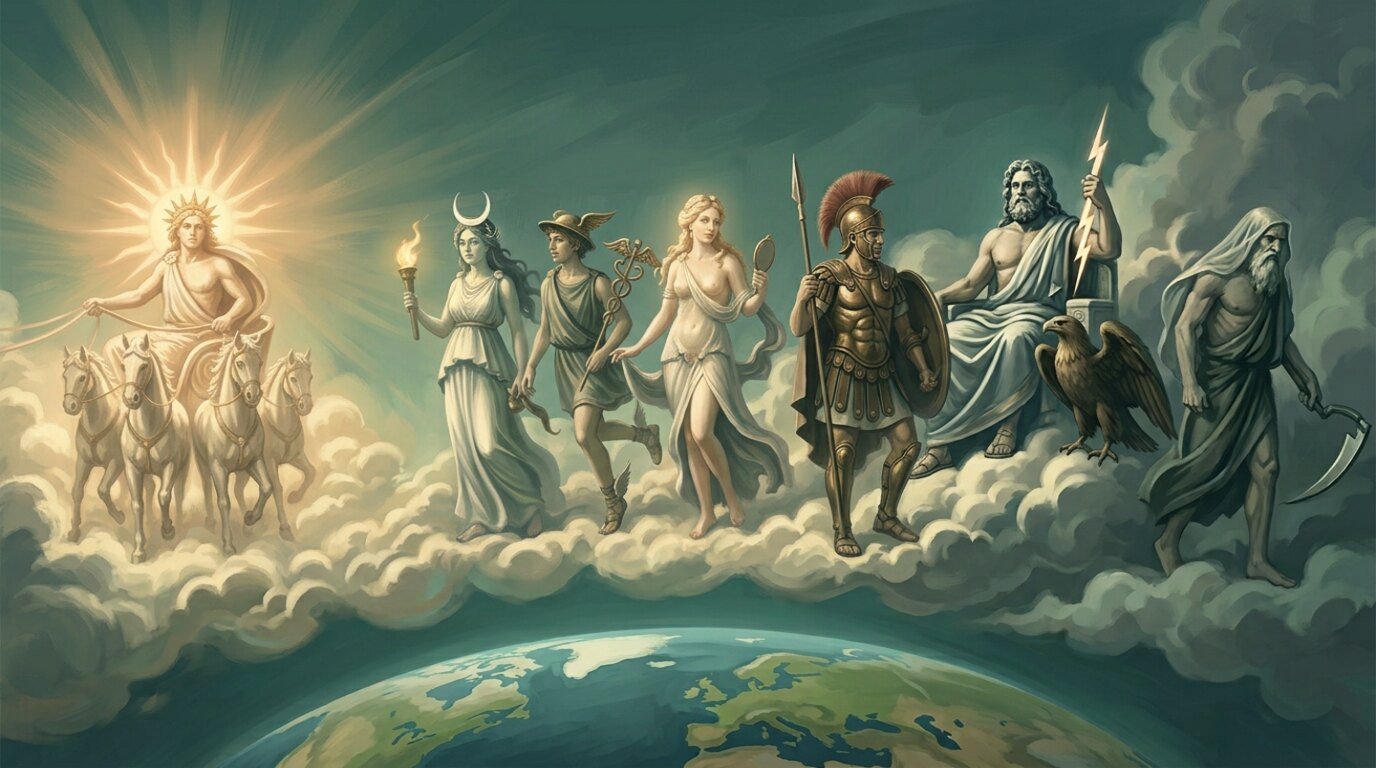
Before Paul, kosmokratōr lived mainly in astrology and magic, and there it was a word of power and reverence, not condemnation. In astrology it named the planets, called kosmokratores because they were believed to “exercise a fateful influence over man” — they governed fate itself. The unease the word carried in that world was about destiny, not evil: the planets were awesome, ordering, capricious, authoritative, and much ancient magic existed precisely to win “release from this tyranny of the heavenly bodies.”[8]
In the surviving magical handbooks (the Greek Magical Papyri), the word is spoken most often to the sun-god Helios — and it is an exalted honor, addressed to a great god whose favor and help the practitioner wants:
“I invoke you, the greatest god, eternal lord, world ruler, who are over the world and under the world…”[9]
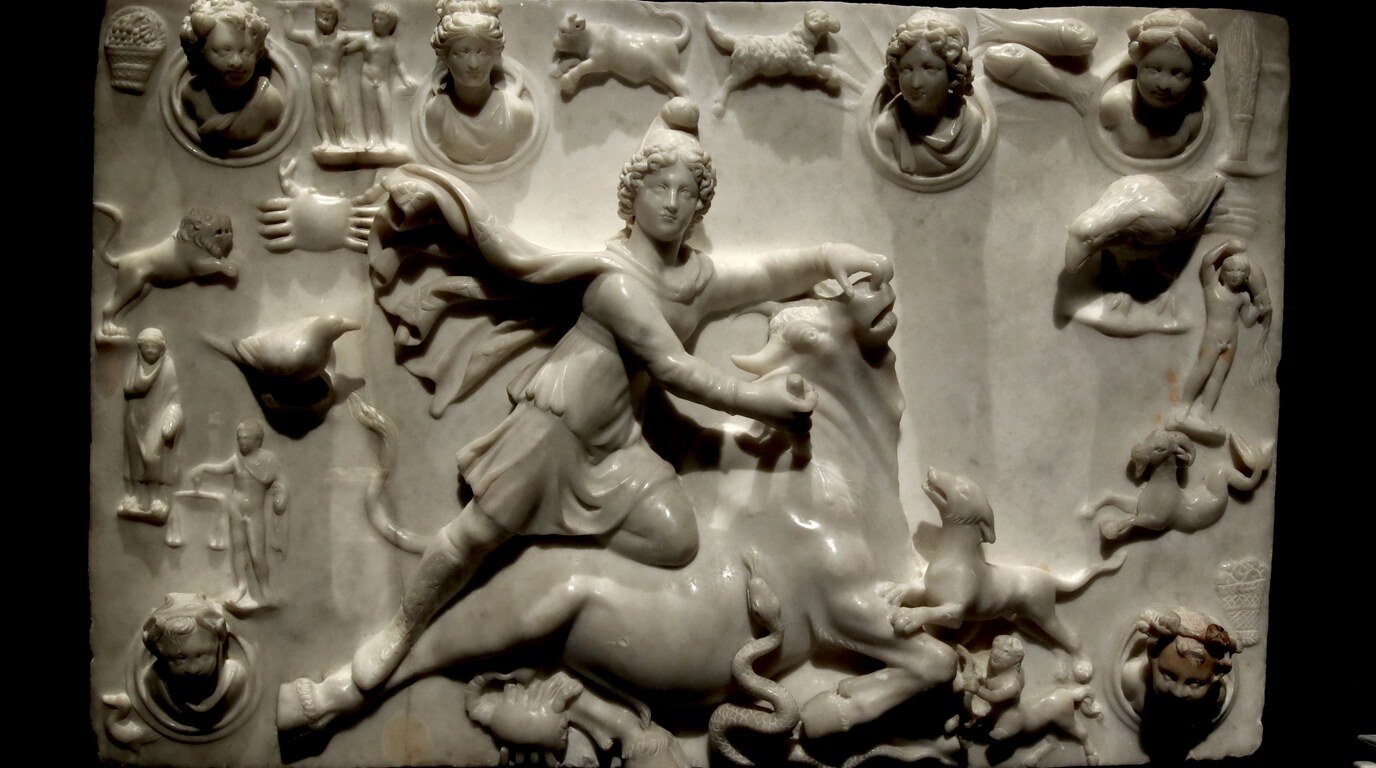
The same title reached a whole roster of great gods — Serapis, Zeus, a fused Zeus-Mithras figure named in a Mithraic inscription, even “heaven” itself in an Orphic hymn — and human rulers too: one Egyptian inscription hails the emperor Caracalla as kosmokratōr, and in the Alexander legend it becomes a stock title for the world-conqueror.[10] (One bearer breaks the pattern — Hermes, a messenger-god rather than a sky-king — a reminder the title clustered on supreme and solar gods but wasn’t reserved strictly for them.)
In Jewish writing, like the Bible, the valuation flips. In the Testament of Solomon, thirty-six star-spirits — the “decans” of the zodiac — tell King Solomon: “We are… the world-rulers of this darkness.” The astral rulers have become demons.[11] It is worth being precise about what changes here: the word takes on its dark charge, but the judgment behind it was old. In the Jewish frame the “gods of the nations” had always been rebel powers set against Israel’s God — the worldview scholars trace to Deuteronomy 32.[12] The Testament of Solomon simply binds that long-standing verdict to this particular word. The “darkness,” in other words, is a claim the Jewish and Christian texts make — not a description the pagan cults would have recognized.
What does Paul do with the word?
Paul takes this astrology-and-magic word and turns it on hostile spiritual powers — “the world-rulers of this darkness.” Ephesians 6:12 stacks four terms in a rush — rulers, authorities, world-rulers, spiritual forces of evil. These are not a ranked chart of fallen offices, as they are often read. Scholars note they are “not different groups, but more or less synonymous designations of the forces of the devil”; no consistent hierarchy among them can be recovered, and piling them up conveys reach and menace, not an org-chart.[13] Nonetheless, Paul writes with sufficient precision that a distinct intent likely lies behind the inclusion of each word.
Read against the Deuteronomy 32 background, Paul’s point is blunt and freeing at once. The real struggle is “not against flesh and blood” — the enemy is not other people but a cosmic order of powers, the very powers the surrounding culture worshipped and tried to appease. And Paul locates the fight in two arenas at once: “this present darkness” (the world below) and “the heavenly places” (the unseen realm above). For a reader who had spent good money on spells to buy safety from the star-powers, this is not first a call to arms — it is the announcement that those powers have a conqueror.

How has kosmokratoras been understood?
Readers have heard the word differently across the centuries — and where you land shapes how you read the whole of Ephesians 6.
Paul’s first audience, steeped in astrology, would hear “world-rulers of the darkness” and think of the fate-dealing powers they had tried to extol, control, and escape through magic. Heard that way, Ephesians 6:12 sounds less like a battle cry than like liberation: the powers you were enslaved to are the enemy Jesus has already beaten (compare Colossians 1:13, “he has delivered us from the domain of darkness”).
The early church narrowed the word to a single referent. By around AD 180, Irenaeus uses kosmokratōr as a title for the Devil (Slanderer) himself — the many “world-rulers” contracting into one.[14]
Modern scholars divide into three broad camps:
- Clinton Arnold (and Michael Heiser) read the powers as real, personal spirit-beings — the plain sense of the ancient vocabulary.
- Walter Wink reads them as the “inner spirituality” of human institutions — the animating ethos of political and social structures, not separate spirits.
- G. B. Caird and Hendrik Berkhof see them as part of a fallen-but-redeemable created order — real, but creatures.
Where does the evidence point? On the plain sense of the word’s own history, the personal, supernatural reading fits most naturally — and it is the reading this site works from. This word did not name abstractions. It named the Sun, named Zeus, named the planets — powers that people invoked by name, feared as persons, and paid magicians to escape. You do not write a protective spell against “the ethos of an institution.” Wink’s insight still holds a real truth: these powers plainly work through human structures, and Scripture takes that seriously; Caird and Berkhof are right that whatever they are, they are creatures, not rivals to God. But on the evidence of Paul’s vocabulary, the “cosmic powers” he names are more than a metaphor for bad systems.
A word on how we handle the sources here. Representing Helios, or the astrologers’ planets, or the magicians’ invocations in their own voice — as honors, not curses — is a matter of accuracy, not endorsement. The aim is that a reader who knows those sources finds them described truthfully, and can then weigh, in the same plain terms, what the biblical writers say about the same powers: that they are real, that they are hostile, and that they are already beaten.
What responses do humans have?
The “cosmic ruler” was never a single god — it was a role, and different cultures filled it with their own supreme sky-god, then identified those gods with one another. Greek Helios was equated with Roman Sol and Egyptian Ra; Zeus with Roman Jupiter; Serapis was deliberately built to be several gods at once.[15] Same office, many faces — and Paul writes straight into that world of shuffling and rebranding cosmic sovereigns.
His move is to take that whole class of “world-rulers” and re-file it. They are not gods to be enlisted with spells; they are powers of darkness to be resisted — and, more than resisted, already broken. That is the letter’s own resolution: at the cross, God “disarmed the rulers and authorities and put them to open shame, by triumphing over them” (Colossians 2:15). The word Paul chose makes the point sharper than any paraphrase. Over every self-styled kosmokratōr — every sun that was worshipped, every planet that was feared, every power that claimed to rule the world — stands the true Pantokratōr, the Almighty, who has already won.
Related reading: A Word of Caution · How we study the unseen (Methodology).
Common questions
How do you pronounce kosmokratoras?
Roughly koz-mo-KRAT-or (plural kosmokratores); the Ephesians 6:12 form is kosmokratoras.
Is kosmokratōr just another word for Satan?
Not originally — Paul uses the plural for a class of powers. Later, the church (Irenaeus) applied the singular title to the Devil (Greek diabolos, the Slanderer).
Is Ephesians 6:12 a ranking or hierarchy of spiritual forces?
Probably not. The four terms — rulers, authorities, world-rulers, spiritual forces of evil — can be read as overlapping names for one set of enemies, not different ranks in an army. Scholars find no consistent hierarchy among them; even so, it does not follow that Paul had no specific entities in mind for each word.
Are these cosmic powers the same as aliens or the entities people meet in altered states?
Different framework, overlapping territory. In Paul’s world the word named spiritual and astral powers — the planets, the gods, and the spirits behind them — not extraterrestrials. But the underlying question — who or what really runs this world, unseen? — is the same one modern encounter accounts raise, which is why the ancient vocabulary still matters.
References & Sources
- Acts 19:13–19; the sum is given at 19:19. ↑
- Acts 19:23–41; the silversmith Demetrius frames Artemis as the one “whom all Asia and the world worship” (19:27). ↑
- Ephesians 6:12 (ESV). The form in Paul’s sentence is the accusative plural tous kosmokratoras; the dictionary form is κοσμοκράτωρ (kosmokratōr). ↑
- BDAG (Bauer–Danker–Arndt–Gingrich), A Greek-English Lexicon of the New Testament, 3rd ed., s.v. “κοσμοκράτωρ,” p. 497; Dictionary of Deities and Demons in the Bible (DDD), 2nd ed., s.v. “World Rulers,” pp. 907–908. ↑
- BDAG, s.v. “κοσμοκράτωρ,” p. 497. ↑
- David Bentley Hart, The New Testament: A Translation, 2nd ed. (2022), at Ephesians 6:12, is the most literal of the moderns, keeping both halves of the compound and rendering the sibling terms archai and exousiai as “the Archons” and “the Powers.” ↑
- On the ‑κράτωρ formation and its family, see Theological Dictionary of the New Testament (TDNT), vol. 3, s.v. “κράτος” (W. Michaelis), pp. 913–914. The word is late — absent from classical Greek and at home in astrology; Paul borrowed it rather than coined it (cf. Clinton E. Arnold, Powers of Darkness, 1992, p. 163). ↑
- DDD, s.v. “World Rulers,” pp. 907–908 (R. Feldmeier). The same entry notes that the “completely negative sense” of the word arises only later, in early Judaism and Christianity; in its pagan setting it is an honorific. ↑
- The Greek Magical Papyri in Translation, ed. Hans Dieter Betz, 2nd ed. (1992), PGM IV.1596–1715 (a spell to Helios), p. 126. ↑
- DDD, “World Rulers,” pp. 907–908; TDNT 3:913–914. In each setting the word is a title of majesty or legitimacy — for a god, a fate-governing planet, or a world-ruling king — not a term of reproach. ↑
- Testament of Solomon 18 (with the parallel at ch. 8), reproduced in Jay Winter, The Complete Book of Enoch; cf. DDD, “World Rulers,” p. 908. ↑
- On the “Deuteronomy 32 worldview” — the nations placed under lesser divine beings who then turned hostile — see Michael S. Heiser, The Unseen Realm (2015), pp. 112–15; cf. Deuteronomy 32:8–9; Psalm 82; Daniel 10:13, 20. ↑
- TDNT 3:913–914; Michael S. Heiser, The Unseen Realm, pp. 333–34 (and p. 333 n. 23: external usage “provides no consistency in hierarchical meanings”). ↑
- Irenaeus, Against Heresies 1.5.4, applying the title to the devil; cited in DDD, “World Rulers,” p. 908, and BDAG, p. 497. ↑
- On these cross-identifications (interpretatio graeca / romana), see Charles Russell Coulter and Patricia Turner, Encyclopedia of Ancient Deities (2000), s.vv. Helios, Serapis. ↑